

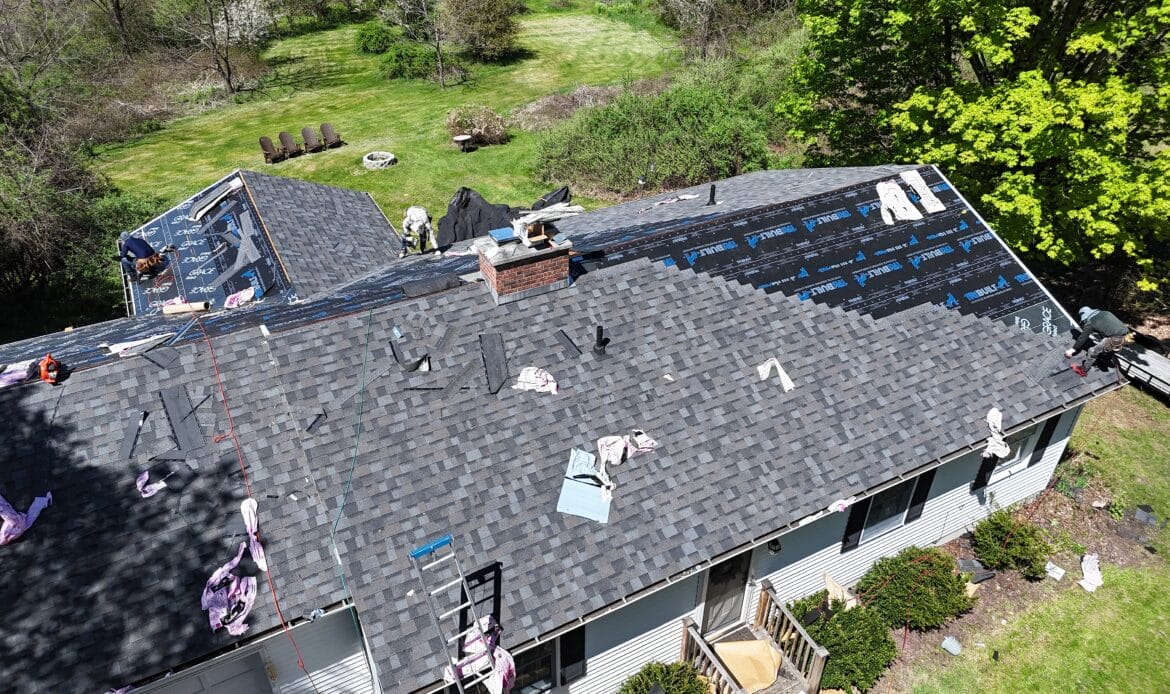
The situations described here are composites drawn from the types of jobs and decisions we encounter regularly. Names and specific figures are illustrative.
A homeowner with a 1960s ranch near Buckingham Pond had three written quotes to replace the same roof. Ours was the third. The low quote was $9,100 and the high quote was $14,900. Her question was the one we hear most every fall about a roof replacement in Albany, NY: why are three quotes for the same roof almost $6,000 apart, and is it safe to wait until spring to decide?
The roof had been put on around 2002. Three-tab shingles, a single chimney, one bathroom vent stack, a kitchen fan through the roof and no ridge vent. The gutters were full of granules every time she cleaned them, and last March a brown ring had shown up on the hallway ceiling after a thaw. Nothing was dripping. But she had been told by a neighbor, a home inspector and one of the roofers that the roof was near the end of its life.
Where the $5,800 actually came from
Most homeowners assume a spread like that means one roofer is cheap and another is greedy. Sometimes that is true. More often the quotes are pricing different jobs and calling them all the same thing. So before talking about our number, we went line by line through all three with her.
The first thing we checked was the drip edge. At the lower corner of the garage roof you could see two shingle edges stacked on each other. The house had two layers, not one. The low quote said “remove existing shingles” and priced disposal for roughly 26 squares. Two layers means roughly twice the tear-off weight, twice the dumpster tonnage and more labor. That number would go up once the crew found the second layer, and the contract had a change-order clause that allowed it.
Here is how the three lined up once we sorted the scope into the same rows:
| Line item | Quote A ($9,100) | Quote B ($12,600) | Quote C ($14,900) |
|---|---|---|---|
| Tear-off | One layer priced | Both layers | Both layers |
| Decking | “As needed,” no price | 2 sheets included, $95 per extra sheet | 4 sheets included, $120 per extra sheet |
| Ice barrier | Eaves only | Eaves, valley, around chimney | Eaves, valley, chimney, plus full lower 6 feet |
| Chimney flashing | Reuse existing | New step and counterflashing | New step and counterflashing |
| Ventilation | Not mentioned | Ridge vent, soffit vents checked and cleared | Ridge vent and new soffit panels |
| Shingle and warranty | Architectural, standard warranty | Architectural, extended manufacturer warranty | Premium designer line, extended warranty |
Seen that way, the low quote was not really $9,100. With the second layer, a realistic amount of decking and new flashing at the chimney, it was going to land somewhere close to the middle quote, and it would get there through change orders instead of a number she agreed to up front.
“We inspect the roof first, then give you a written, line-item quote so you can see what is included. We diagnose first and quote honestly, with no upselling.”
Paul Sandul, Owner, Elite Contracting
The lines that looked like padding and were not
Two items in the higher quotes looked like upsells to her. The first was the ice barrier. In the Capital Region, the self-adhering membrane at the eaves is not optional. The Residential Code of New York State, section R905.1.2, calls for it from the eave edge to at least 24 inches inside the exterior wall line, and towns around here, Stillwater among them, ask contractors to certify it in writing for the permit file. On a ranch with a 2-foot overhang, a single 3-foot course does not reach far enough. That is why two rows at the eaves is the usual minimum, and why we add it around the chimney and in the one valley where meltwater collects. We have written before about the ice-and-water shield conversation most quotes skip, and this house was a clear example.
The second was the chimney. Reusing old step flashing on a tear-off saves an hour or two. It also leaves 24-year-old metal under a new roof that should last another 25 years. The brown ring on her hallway ceiling sat about four feet from that chimney. We could not promise that was the source until the shingles came off, but it was the most likely candidate, and the low quote left it in place.
Ventilation was the third. The house had soffit vents painted shut and two small box vents near the peak. That combination is part of why the shingles on the south slope had overheated and lost their granules faster. A ridge vent only helps if air can come in at the soffits, so we wrote in clearing them, not just cutting a slot at the top.
Where spending more stopped making sense
The high quote was not wrong. It priced a different roof. The extra membrane on the full lower 6 feet makes sense on a low-slope porch or a house with a long ice-dam history, and this one had neither. Its walls were not showing stains at the eaves and the attic had no frost lines on the nails along the bottom edge. The designer shingle line was a look she liked, but on a one-story ranch where most of the roof is visible only from the street, she decided it was not worth about $1,800 of the difference.
New soffit panels were the closer call. The existing aluminum soffit was fine once the vents were opened up. Replacing it would have been cosmetic. That is the point we usually see on a house like this: once the tear-off, decking, ice barrier, flashing and air path are handled, extra money buys appearance and peace of mind, not water protection. Both are legitimate things to buy. They just belong in a separate conversation.
For anyone weighing a different material altogether, our longer comparison of metal versus shingle roofs for Albany homes walks through how the lifetime cost math changes. She stayed with architectural shingles.
Sign in October or wait for April
This is the part of the conversation that happens on almost every fall estimate. She had read that shingles should not go on in the cold. That is partly right. Owens Corning’s cold-weather bulletin says that when air and surface temperatures are at or below 40°F, the factory sealant strips may not bond until warmer weather, and it calls for hand sealing shingles around the roof perimeter with dabs of asphalt roof cement. That is extra labor, not a reason to stop. We do it on late-season jobs as a matter of course.
The real question was what waiting would cost her. Here is how we laid out the two timelines:
| Question | Install late October or November | Wait until April or May |
|---|---|---|
| Winter exposure | New ice barrier and flashing in place before the first freeze-thaw cycles | Old flashing and two worn layers ride out another winter |
| Shingle sealing | Perimeter hand sealed; field shingles finish sealing on sunny days and in spring | Strips seal within days in warm sun |
| Scheduling | Weather windows are shorter, so dates can shift by a few days | Spring calendars fill quickly after the first thaw |
| Price | Quote held as written | Quote would need to be re-issued in spring |
With a stain already on the ceiling and a chimney that had been flashed decades ago, she did not want to find out in February whether the brown ring would come back as a drip. She signed in mid-October. If the roof had been dry, with one layer and no stains, waiting would have been a reasonable choice, and we told her so.
What the tear-off turned up
The crew removed both layers. The chimney was the leak. The old step flashing had been bent back and caulked over at some point, and the caulk had split on the uphill side. The plywood under it was dark and soft in a patch about the size of two sheets. A third sheet near the bathroom vent stack had delaminated, and there was a fourth at the lower corner of the garage where the old gutter had overflowed for years.
Our quote included two sheets. The other two were billed at the $95 per sheet written into the contract, so the final invoice came to $12,790 instead of $12,600. The invoice went up, but only by an amount she had already seen in writing, which was the point of having the per-sheet price on paper before anyone climbed a ladder. The roof was dried in that afternoon and finished the next day, with the perimeter hand sealed because the overnight lows were in the 30s.
If she had gone with the low quote, the same four sheets, the second layer and the chimney flashing would all have been change orders. Whether that would have ended up higher or lower than our number is hard to say. What is clear is that she would have been deciding those items in the middle of the job with the roof open, instead of before she signed.
What homeowners usually ask us at this point
“Is the cheapest quote always the one to avoid?” No. Sometimes the low quote is the most honest one because the roof really is simple. The National Roofing Contractors Association’s own guidance says to keep a healthy skepticism about the lowest bid and to insist on a written proposal with complete descriptions of the work, specifications, dates and payment terms. The useful test is whether you can match every line in one quote to a line in the others.
“What should be in writing?” In New York, quite a lot. General Business Law section 771 requires home improvement contracts to be in writing and signed, and the New York Attorney General’s home improvement fact sheet notes that contractors must either hold progress payments in escrow or post a bond, and that the contract has to give you three business days to cancel in writing. If a roofer will not put the decking price per sheet in writing, ask why before you sign.
“How long should a new shingle roof last here?” A well-installed architectural shingle with real ventilation and a proper ice barrier commonly runs 20 to 25 years in the Capital Region, sometimes longer on north slopes. Her 2002 three-tab roof made it about 24, with half the venting it needed. If the cost of financing is part of the decision, our post on financing a roof replacement without getting rolled covers what to watch for in the paperwork.
“Does a new roof pay for itself when I sell?” Partly. The 2025 Cost vs. Value report from the Journal of Light Construction estimated that a national-average asphalt shingle roof replacement recoups about two-thirds of its cost at resale. The rest is what you pay for a dry house and a cleaner home inspection.
What we would tell the next person holding three quotes
A wide spread between quotes is usually a sign that the roofers saw different houses, not that one of them is honest and two are not. If you can get each quote into the same six rows, tear-off, decking, ice barrier, flashing, ventilation and shingle, most of the gap is explained. Whatever is left over is the part worth negotiating or walking away from.
Timing follows the same logic. A dry, single-layer roof with no stains can usually wait for spring. A roof with two layers, an old chimney flashing and a stain already on the ceiling is a different conversation in late October. That is how most decisions about a roof replacement in Albany, NY are made: based less on the season and more on the condition the roof is already in. For a broader look at how we approach residential jobs, our residential roofing work in Albany page covers the materials and process.
If you are comparing quotes for a full roof replacement in the Capital Region, you can reach out here.
Sources
- Certification of Placement of Ice and Water Protection (Residential Code of New York State, section 905.1.2), Town of Stillwater, NY
- Technical Bulletin: Cold Weather Shingle Installation, Owens Corning Roofing
- Selecting a Contractor, National Roofing Contractors Association
- Home Improvement Fact Sheet, New York State Attorney General
- N.Y. General Business Law Section 771: Contract provisions
- Cost vs. Value 2025: National Results, Journal of Light Construction