

Flat roofs are a different animal. Everything that keeps a pitched roof healthy — slope-driven water shedding, straightforward flashing details, seasonal snow-load behavior — works differently once the roof is flat or low-slope. Most of what homeowners and small building owners get wrong about flat roofs comes from applying pitched-roof intuition to a system that doesn’t share the same physics.
This is the walkthrough of what actually matters on a flat roof in the Capital Region, in the order it matters. Written for the homeowner with a flat porch extension, the small building owner with a mod-bit roof over the addition, and the property manager weighing coating versus replacement on a 4,000-square-foot commercial roof. My brothers Vlad and Dan and I have been on Albany, Troy, Schenectady, and Clifton Park flat roofs since 2016. What follows is honest.
Why flat isn’t really flat
The first thing to understand: no properly-installed flat roof is actually flat. Every roof we install has a designed pitch — usually a quarter inch to a half inch per foot — that moves water off the surface toward drains or scuppers. When a homeowner tells me their roof is “flat,” what they usually have is a low-slope roof engineered to move water, and the question isn’t whether water leaves the roof but whether it leaves quickly enough that nothing sits.
Standing water — ponding — is the single most common flat-roof problem in the Capital Region. It’s caused by insulation settling, structural sag over time, drain clogs, or an original install that didn’t establish enough slope. Every extra day water sits on the membrane, the membrane’s service life shortens. Ponding is what kills flat roofs first.
The three membrane systems that matter
Most flat roofs in the Capital Region are one of three membrane types.
TPO (Thermoplastic Polyolefin) is the modern default for new commercial and some residential flat installs. Wide rolls, welded seams, reflective white surface that cuts summer HVAC load. Service life 20–30 years when installed well. The welded seams are dramatically stronger than the glued seams on older systems, which matters because seams are where most flat roofs eventually fail.
EPDM (Ethylene Propylene Diene Monomer) is the black rubber membrane you see on many older flat roofs. Long track record in Upstate NY, easily repairable, cold-weather tolerant. Service life 20–30 years. The tradeoff: black surface absorbs heat, driving up HVAC costs on air-conditioned buildings, and the seam adhesive can weaken after 15–20 years.
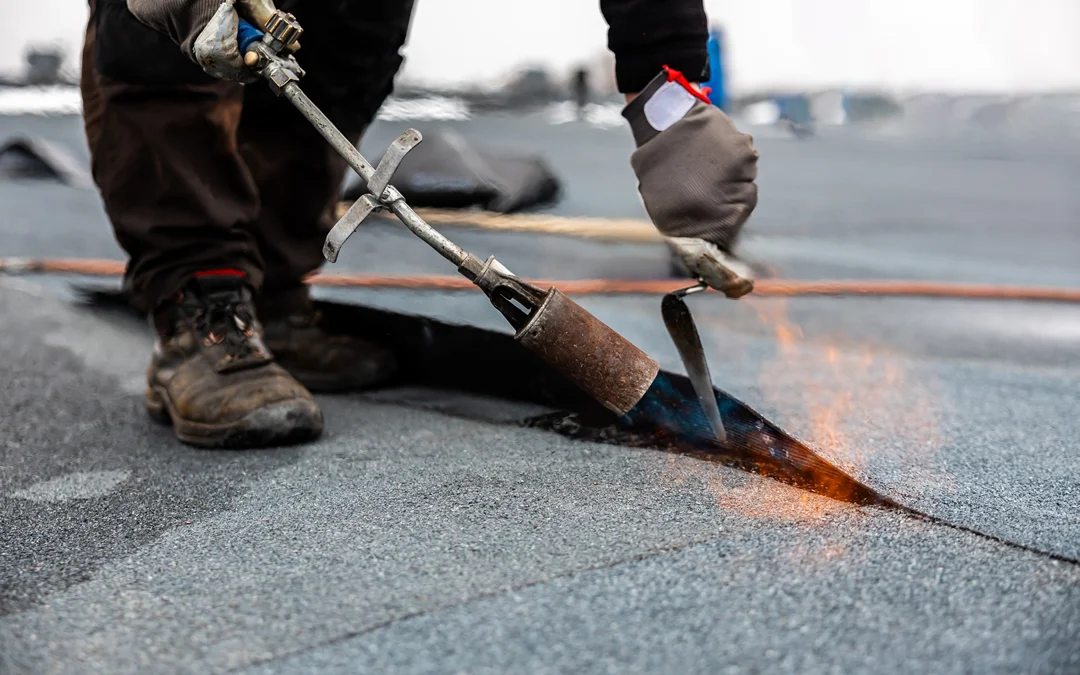
Modified Bitumen (mod-bit) is an asphalt-based membrane installed in multiple layers. Excellent puncture resistance — critical if there’s foot traffic on the roof for HVAC service or similar. Service life 15–25 years. Torch-down installation carries fire risk that some codes restrict.
Which system is right for your specific roof depends on the current membrane’s condition, HVAC load, foot traffic, structural weight capacity, and how long you’re planning to hold the building. There isn’t a universally correct answer. There is a right answer for your specific building, and it takes a real diagnostic conversation.
What kills flat roofs
Understanding the failure modes tells you what to watch for and what to prioritize on maintenance.
Ponding damage. Standing water accelerates membrane breakdown, causes seams to weaken, and — over years — deflects the underlying structure further, deepening the ponding. Anything that improves drainage extends roof life.
Seam failure. Every flat roof has seams where membrane sections join. On old EPDM with glued seams, adhesive dries out over time. On TPO with welded seams, the welds are much more durable but can still fail at penetrations and edges if the original weld quality was poor.
Flashing failure at penetrations. HVAC curbs, roof drains, vent stacks, skylights, and any other roof-plane penetration is a joint. Joints fail before fields do. Most flat-roof leaks trace to a specific penetration, not to the membrane field itself.
Insulation moisture damage. When water breaches the membrane and enters the underlying insulation, the insulation compresses, R-value drops, and the wet section becomes a permanent weak point. Moisture surveys on older flat roofs identify these areas before they become full membrane failures.
Foot traffic damage. Punctures from HVAC service, satellite installation, or maintenance foot traffic. Some damage is instantaneous; some accumulates over years.
The coating decision
Flat roofs in the 15-to-25-year age range are the most common decision point we walk building owners through. Coat the existing membrane and extend life 5–15 years? Or tear off and replace with a new 25-year system?
Coating works when the existing membrane is structurally sound, the underlying insulation is intact, and the building hold horizon is 10–15 years. A silicone or acrylic coating goes on top of the prepped existing roof, bridges seams, and reflects UV. Cost is 40–60% of a full replacement.
Replacement wins when the existing membrane has failed structurally, the insulation has taken water damage, or the building hold horizon is long (25+ years). Coating a badly aged roof just defers the inevitable while sometimes making the eventual tear-off more complicated.
The economics matter. We walk through the specific coating-versus-replacement math on your building on every diagnosis visit.
The inspection cadence
Flat roofs need more attention than pitched roofs. The recommended cadence:
Every 2–3 years for new roofs. Professional inspection with a full walk, drain check, penetration flashing review, and written condition report.
Annually for roofs over 15 years old. Same walk, same report. What we’re watching for shifts — earlier the concern is drainage and maintenance; later it’s the coating-vs-replacement decision.
After every major storm. Hail, hurricane-force winds, or ice storm events warrant a same-week walk to catch damage before it compounds.
Semi-annually for critical buildings. Commercial buildings with high interior damage risk (medical, data center, retail with sensitive inventory) benefit from spring and fall inspections.
Elite offers inspection contracts for regular clients on annual or semi-annual schedules. For new clients, an inspection runs $500–1,500 depending on building size, typically credited toward any repair or coating work that gets triggered.
Ponding — the quiet killer
Ponding is worth a section of its own because it’s the single most common flat-roof issue in the Capital Region and the one most homeowners and building owners don’t recognize until damage has compounded.
What to look for. After a rain event, walk the roof (or watch from a window with a view). Areas where water still sits 48 hours after the rain stopped are ponding areas. Not necessarily catastrophic on their own, but they’ll compound over time.
Common causes. Insulation settling around drains that no longer sit at the low point. Structural deflection between rafters. Clogged drains that back water up. Original install that didn’t establish enough slope. Additions to the building that changed drainage patterns.
What to do. Sometimes drainage improvement is a matter of clearing debris around drains and scuppers. Sometimes it requires tapered insulation to reestablish slope. Sometimes it requires a full replacement to properly address structural deflection. The right fix depends on the specific cause on your specific roof, and we diagnose it on the walk.
What the Elite process looks like
On any flat-roof diagnosis in the Capital Region:
- We walk the entire roof with time — usually 45 minutes to 2 hours depending on building size
- Every penetration gets photographed and checked
- Every drain and scupper gets tested for free flow
- Moisture surveys on any roof 15+ years old to check underlying insulation
- Written condition report with photographs
- Coating vs. replacement recommendation if the age warrants that conversation
- Insurance claim documentation when applicable
Paul Sandul, Elite Contracting. Family-owned. Owens Corning Preferred. Clifton Park.
Sister topics
For deeper reading on specific flat-roof decisions:
- Comparative overview: Flat vs. Pitched Roofs — Which Fits Your Building
- Drainage failure specifics: Flat Roof Drainage in Upstate NY
- Contractor selection: What to Ask Before Hiring a Flat Roofer
- Scam avoidance: How to Avoid Flat-Roofing Scams
This is the pillar guide for our flat roofing service. For the full service overview, project timelines, and free estimate scheduling, visit our Flat Roofing service page. Paul Sandul, Elite Contracting.