

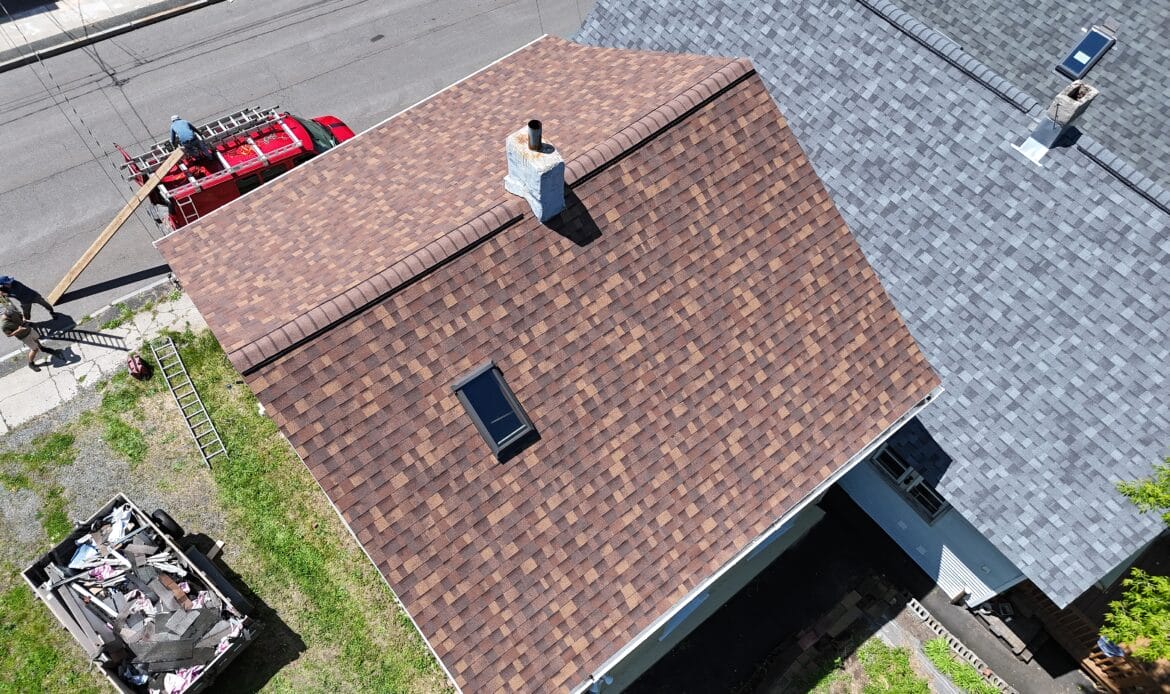
The situations described here are composites drawn from the types of jobs and decisions we encounter regularly. Names and specific figures are illustrative.
The request came the first week of October. A homeowner in a 1998 colonial off Route 146 had turned the furnace on for the first time that weekend, and by Sunday night there was a towel on the family room floor under one of the two skylights in the cathedral ceiling. It had rained Saturday. It had not rained Sunday. Both skylights had a damp brown edge on the drywall. The question on the phone was the one we hear a lot this time of year: is this skylight leak repair in Clifton Park, NY, or is it just condensation that will go away on its own?
The honest answer was that it could be either, or both. Fall in the Capital Region is when both show up at once: the first rains with leaves on the roof test the flashing, and the first nights the heat runs test the glass. The fix for one does nothing for the other.
What the drips were saying before anyone went up the ladder
Inside, the two skylights told different stories. The left unit had a stain on the drywall at the upper corner of the shaft, the uphill side. The paper was soft. The right unit had water beading on the inside of the frame and a faint fog trapped between the two panes of glass, the kind you can’t wipe off from either side.
The homeowners had also just had a humidifier installed on the furnace the previous winter, and someone had left the dial near the top setting. The hygrometer on the thermostat read 58 percent. The EPA suggests keeping indoor humidity below 60 percent and ideally between 30 and 50 percent to limit moisture problems. At 58 percent with cold glass overhead, the warm air in a vaulted room has nowhere to go but up to the coldest surface in the house.
We use a rough sorting rule on these calls. It is not perfect, but it points the inspection in the right direction.
| What you notice | Usually points to a leak | Usually points to condensation |
|---|---|---|
| When it drips | During or right after rain or snowmelt | Cold mornings, dry days, after showers or cooking |
| Where the stain sits | Drywall at the top or sides of the shaft | Frame, sill, and glass edge, often all four sides |
| The glass | Usually clear | Beaded inside, or fogged between panes if the seal failed |
| Indoor humidity | Normal | High, often above 50 percent once the heat comes on |
By that chart, the left skylight looked like a leak and the right one looked like condensation. The roof had to confirm it.
What the roof showed on the left skylight
The shingles on this house were 13 years old. The previous roofer, during a 2013 re-roof, had kept the original 1998 skylights and reused the old flashing. That is common, and it is where a lot of skylight leaks in Clifton Park start. When old step flashing gets bent during a tear-off, the easy move is to bed it in roof cement and face-nail the shingles around it. It holds for a while.
On the left unit, the head flashing at the top of the skylight had been sealed with a bead of black cement that had cracked open along most of its length. There was a mat of wet maple leaves packed against the uphill side, holding water right at that crack. When we lifted the first course of shingles above the skylight, the nails underneath were rusted, and the felt was stained in a fan shape running down toward the corner of the frame. That rusted-nail pattern is a common sign that water is getting in through the roofing and flashing around the skylight rather than through the skylight itself. We covered the same idea in more detail in our write-up on where roofs actually leak.
The 2020 Residential Code of New York State calls for flashing around roof openings, and when a roof is re-covered, flashing that is damaged or deteriorated is supposed to be replaced and installed to the manufacturer’s instructions. Caulk is not flashing. It was doing the job of flashing on this skylight, and it had run out of time.
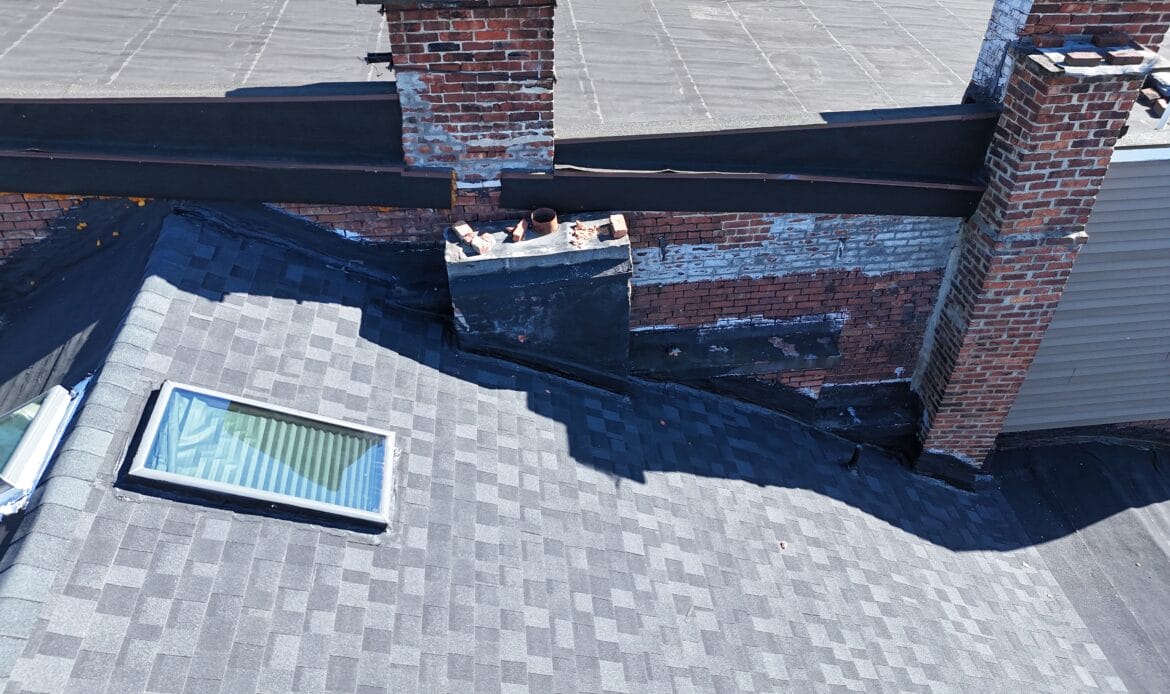
What the right skylight was actually doing
The right unit’s flashing was in better shape. It was old, but it was lapped correctly and the shingles around it were tight. No rusted nails, no staining in the felt. From the roof, there was nothing to fix.
From inside, the story was different. The fog between the panes meant the insulated glass seal had failed, so the glass was performing closer to a single pane. On a 40-degree night, that inner pane got cold enough for the 58-percent air to condense on it and run down into the frame. When we pulled a piece of trim back at the shaft, there was no insulation and no felt between the skylight frame and the rough opening. VELUX notes that when an installer leaves out felt and insulation in that gap, warm, moist room air reaches the underside of the flashing and cladding, condenses, and drips back into the room in a way that looks like a leak. That is what this was.
So one skylight had a roof problem. The other had a glass problem and an air problem. The homeowners had been prepared for one bill, and now they had two different conversations.
The three ways it could go
This is the point where a lot of homeowners expect us to push the biggest option. We laid out three, with rough numbers for this house.
| Option (per skylight) | Rough cost on this job | What it fixes | What it leaves behind |
|---|---|---|---|
| Reflash the existing unit | $450 to $700 | The roof leak on the left unit | 28-year-old glass, failed seal on the right unit, no warranty on the old frame |
| Replace with a new same-size unit and factory flashing kit | $1,700 to $2,300 | Flashing, glass, and the insulation gap at the frame | Interior paint touch-up at the shaft |
| Remove and deck over | $900 to $1,400, plus interior drywall by others | Removes the opening for good | A darker room and a patched ceiling |
Reflashing the left skylight alone was the cheapest way to stop Saturday’s drip. It would have done nothing for the right skylight, which needed new glass either way. And reflashing a 28-year-old unit means paying for careful labor around a frame and sash that have already been moved once during a tear-off. Remodeling trade coverage makes the same point about re-roofing: old flashing gets damaged coming off, and the frame connections on an old unit can get weakened if it gets bumped.
Decking over came up because the room gets afternoon sun through the west windows. The homeowners decided they wanted the light, especially in December.
Why they kept the size and kept the roof
One detail mattered more than the homeowners expected. Changing a skylight’s size changes the rough opening, the drywall in the shaft, and the interior trim. We do not do interior trim carpentry, and we say that up front, because a skylight resize can leave a homeowner with a finished roof and an unfinished ceiling while they wait on another trade. Ordering the new units in the same size as the 1998 openings meant the interior stayed as it was, apart from a coat of paint where the stain had been.
The second question was whether to do the whole roof now. The shingles were 13 years old, lying flat, with granules still on them. There was no curling at the rakes and no soft decking anywhere we walked. A full roof replacement would have meant new skylights and new shingles on the same warranty clock, which is a real advantage. But it would also have meant spending around $12,000 ahead of need on a roof that likely had more than a decade left. That is the point where spending more stopped making sense for this house. The new skylights went in with new flashing kits, and the shingles around them were woven back in. When the roof does come due, the skylights will be the newest part of it and can stay.
Timing helped. Shingles we lift around a skylight need a few warm afternoons to reseal their adhesive strips. Mid-October in Clifton Park usually still gives us that. By December, it is less reliable, and we end up hand-sealing tabs that the sun would normally have taken care of.
What homeowners usually ask at this point
The first question was whether we could just caulk the left one and come back in the spring. We could have. It would probably have held through a dry stretch. But the leaves were going to keep landing on that roof for another month, and once snow sits against a cracked head flashing, the melt runs into the same gap. A caulked skylight in October tends to turn into a stained ceiling in February.
The second was whether new skylights would make the condensation go away on their own. Mostly, but not entirely. New double-pane glass with an intact seal runs warmer on the inside, and filling the gap between the frame and the rough opening with insulation takes away the cold path. But at 58 percent indoor humidity, almost any glass in a vaulted ceiling will sweat on a 20-degree morning. The humidifier went down to the low 40s, and that did as much as the new glass.
The third was about energy. Skylights certified under ENERGY STAR are independently tested against efficiency guidelines, and the program says certified windows, doors, and skylights can cut heating and cooling costs by up to 13 percent on average nationwide compared with non-certified products. We told the homeowners not to expect a dramatic heating bill change from two skylights. The comfort change under them was more noticeable.
How the first cold snap went
The first hard frost came about two weeks later. The homeowners sent a photo of the inside glass at 6:30 in the morning: a thin line of beading at the very bottom edge, gone by eight, nothing running down the frame. It rained hard the following weekend with leaves still coming down. The new head flashing kept the water moving around the unit and down the slope, and the ceiling stayed dry.
The part they said they would have done differently was the humidifier. If they had kept it lower the winter before, the right skylight would have been less of a surprise.
What to take from it
If a skylight starts dripping when the heat comes on in October, it is worth separating the two possible problems before deciding anything. A leak lives in the flashing. Condensation lives in the glass and the air. A skylight that has been reflashed or caulked during a past re-roof, and is now past 20 years old, is usually a better candidate for replacement than for a second round of patching. One that is newer, with clear glass and a tight frame, often just needs a focused roof repair visit at the head flashing and a lower humidity setting inside.
If you are not sure what you are looking at, a quick attic and ceiling check before calling anyone will tell you a lot about whether water is coming from above or forming inside. And if the shingles around the skylight are near the end of their life, that changes the math. We walked through a similar repair-or-replace decision in last month’s Clifton Park fall inspection story.
Most of the skylight leak repair in Clifton Park, NY we see in the fall comes down to one of the two problems in this house, and fairly often both. The fix is rarely complicated once you know which one you are dealing with.
If you’re looking for residential roofing in the Capital Region, you can reach out here.
Sources
- A Brief Guide to Mold, Moisture, and Your Home, U.S. Environmental Protection Agency
- Why is my skylight leaking?, VELUX USA Help Center
- FS Skylight: Condensation on Back of Profile, VELUX USA service guide (PDF)
- 2020 Residential Code of New York State, Chapter 9 Roof Assemblies (flashing and reroofing), International Code Council
- How to Reflash a Leaky Skylight, Pro Trade Craft
- 5 Reasons to Replace Skylights During Reroofing, Journal of Light Construction
- Residential Windows, Doors and Skylights, ENERGY STAR