

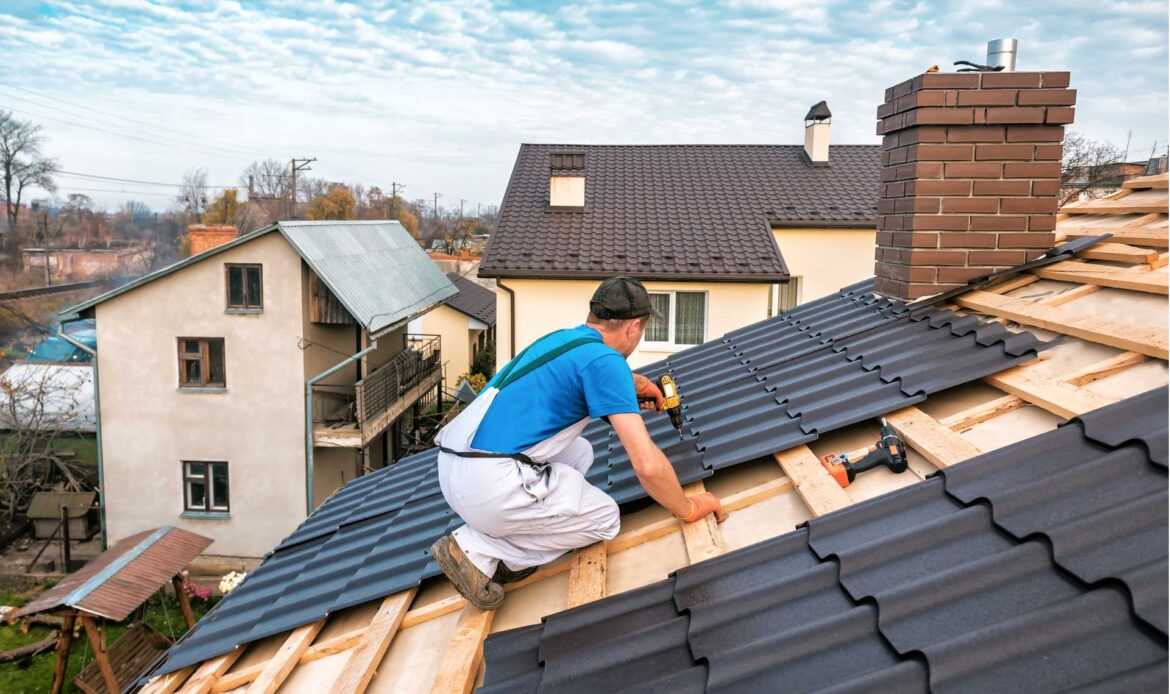
Most homeowners who call us about metal roofing have already read a dozen articles online — and most of those articles were written by companies that only install one system, so the answer they wrote was always “our system.” This one isn’t that. My brothers Vlad and Dan and I have installed standing seam and exposed-fastener metal roofs on homes across the Capital Region for almost a decade. What follows is the honest walkthrough of the decisions you have to make, in the order you have to make them.
If you’re weighing metal against asphalt, you’re not alone — it’s the single most common cross-material comparison we get on quote calls. But metal is not one product. It’s a category of products with wildly different price points, install methods, service lives, and winter behavior in our climate. Getting the decision right means knowing which conversation you’re actually in.
The first decision: standing seam or exposed fastener
Standing seam and exposed-fastener metal are both “metal roofing.” They’re not the same product.
Standing seam uses long vertical panels with concealed fasteners hidden inside raised seams. The panels lock together mechanically or with a specialized seaming tool. There are no exposed screws on the roof surface, which means nothing to back out, nothing to rust, nothing to fail from thermal cycling over the decades. The tradeoff: standing seam is more expensive to fabricate and takes longer to install. It’s what we recommend for houses where the metal roof is the finished aesthetic — visible from the street, part of the home’s architecture, meant to last 50-plus years.
Exposed-fastener metal uses corrugated or ribbed panels held down by visible screws with rubber gaskets. It’s faster to install, considerably less expensive, and it’s the metal-roof product most people see on agricultural buildings, garages, and porches. The tradeoff: the rubber gaskets on the exposed screws are the failure point. Every 15–20 years in our climate, those gaskets dry out and cycle out, and the roof needs re-fastening. Not the end of the world, but planned maintenance.
For a primary house roof in the Capital Region where curb appeal and long-term hands-off performance matter, we lean standing seam. For a garage, workshop, or porch overhang, exposed-fastener is often the right choice. We’ll walk you through which of the two your specific project should be on our diagnosis visit.
The second decision: aluminum or steel
Once you’ve picked a system, you pick a metal. This is where a lot of the online articles get simplified in ways that hurt homeowners.
Steel — usually galvanized or Galvalume-coated — is the workhorse. Stronger than aluminum, more common in Upstate NY installations, and generally less expensive per square. Modern coatings on steel roofs give them a service life comfortably north of 50 years in our climate.
Aluminum is lighter, doesn’t rust (it oxidizes, but the oxide layer is stable), and is often chosen for coastal applications where salt air would eat steel. In the Capital Region we’re not coastal, so aluminum’s rust-resistance advantage is less relevant. Aluminum can dent more easily under hail, which matters if you’re on a slope where a tree could shed a branch.
For most Capital Region homes, we spec Galvalume-coated steel. It performs beautifully in our winter climate, the paint finishes hold up for decades, and the pricing is favorable. Aluminum is available on request and appropriate in specific applications.
Real Upstate NY winter performance
Metal roofs handle Capital Region winters better than most people realize. A well-designed metal roof:
Sheds snow. The smooth surface, combined with proper pitch, means snow slides off in warmer stretches rather than building up into ice dams. This is one of the biggest quiet advantages of metal in our climate — you don’t get the eave ice-and-water backup that plagues asphalt roofs after hard winters.
Doesn’t hold ice. Because snow doesn’t accumulate the same way, ice dams don’t form the same way. We’ve done metal replacements on houses where the original asphalt had been fighting ice dam damage for a decade, and the ice dam problem simply went away with the material change.
Handles wind well. Standing seam in particular has excellent wind ratings — the mechanical seam is far stronger than shingle adhesive. Winter windstorms that pull tabs off asphalt roofs don’t affect a properly-installed metal roof.
Requires snow guards on many installations. The one caveat: because metal sheds snow so effectively, a large snow load can release from the roof all at once and land somewhere you don’t want it — on a walkway, on a car, on a porch roof. We install snow guards or snow rails on every metal roof where the geometry calls for it. That’s part of the quote, not an add-on.
Insurance considerations
This is a piece most homeowners don’t think about until they’re deep in the decision. Your homeowner’s insurance can treat metal and asphalt differently — and it varies by carrier.
Some insurance carriers offer premium discounts for metal roofs because of their wind resistance and longer service life. Some carriers exclude cosmetic hail damage on metal (dents that don’t affect function) from claims. Some carriers rate a metal roof favorably on Fire Rating (Class A) and give discounts accordingly.
Before you commit to a metal replacement, call your carrier and ask two specific questions: “Will my premium change if I install a metal roof?” and “How is hail damage handled on metal versus asphalt in my policy?” The answers vary. Sometimes the insurance savings alone push metal into positive-ROI territory versus asphalt over 20 years.
When metal pays back over asphalt
Here’s the honest math, which is different from the marketing.
Upfront cost. Standing seam metal costs roughly 2× to 3× a comparable-quality architectural asphalt roof. Exposed-fastener metal costs about 1.5× asphalt.
Service life. A modern metal roof, properly installed, comfortably outlasts two asphalt roofs. Sometimes three.
Maintenance. Metal roofs need less maintenance over their life — no shingle repairs, no granule loss, no boot replacements. Exposed-fastener metal needs periodic fastener maintenance, but that’s minor compared to shingle repairs.
When it pays. Metal is genuinely the better financial decision when you plan to be in the house for 20-plus more years. If you’re selling in 5 years, the payback math doesn’t work — you’re paying the premium and someone else gets the long tail.
For a homeowner in their 40s or 50s planning to stay in the house through retirement, a properly-installed standing seam metal roof is often the last roof they’ll ever put on the house. That’s the frame we use when we walk homeowners through the decision.
The Elite install process
Every metal roof we install starts with a diagnosis visit — same process we use for asphalt. We walk the existing roof, check the deck, measure the geometry, take detailed photos, and write up a scope in plain language. If you go forward with us, here’s what happens:
Tear-off of the existing roof. We don’t install metal over asphalt. The deck needs to be clean and inspected, and any soft or damaged sheathing gets replaced.
Fresh underlayment specific to metal. Metal roofs use a different underlayment spec than asphalt — high-temperature membrane at the eaves, synthetic underlayment across the field, purpose-built ice-and-water shield in the valleys.
Panel fabrication and install. Standing seam panels are fabricated to length on-site with a portable seaming machine, then installed with concealed clips that allow thermal expansion. Exposed-fastener panels come pre-formed and are installed with sealed screws.
Flashing details. Chimney and skylight flashings on a metal roof are custom-formed to match the panel geometry. This is skilled trade work — the difference between a metal roof that leaks in year three and one that doesn’t is entirely in the flashing details.
Snow guards and edge details. Snow guards on the appropriate slopes, drip edge, custom-color trim details as spec’d.
Full-system warranty documentation. As an Owens Corning Preferred Contractor for their asphalt system, we also carry certifications for the metal systems we install. You get manufacturer material warranties on the panels and coating, plus our written 10-year workmanship warranty.
Sister topics
For the full decision context, read these next:
- Repair vs. replace on an existing metal roof: Metal Roofing Repair Near Me
- When metal beats asphalt in harsh conditions: How Metal Roofs Handle Harsh Weather Better Than Shingles
- Real Upstate NY service life: Metal Roof Lifespan Upstate NY
- Cost, timeline, and process: Metal Roof Installation Cost, Timeline, Process
This is the pillar guide for our metal roofing service. For the full service overview, project timeline, warranty documentation, and free estimate scheduling, visit our Metal Roofing service page. Paul Sandul, Elite Contracting — family-owned, Owens Corning Preferred, Clifton Park.