
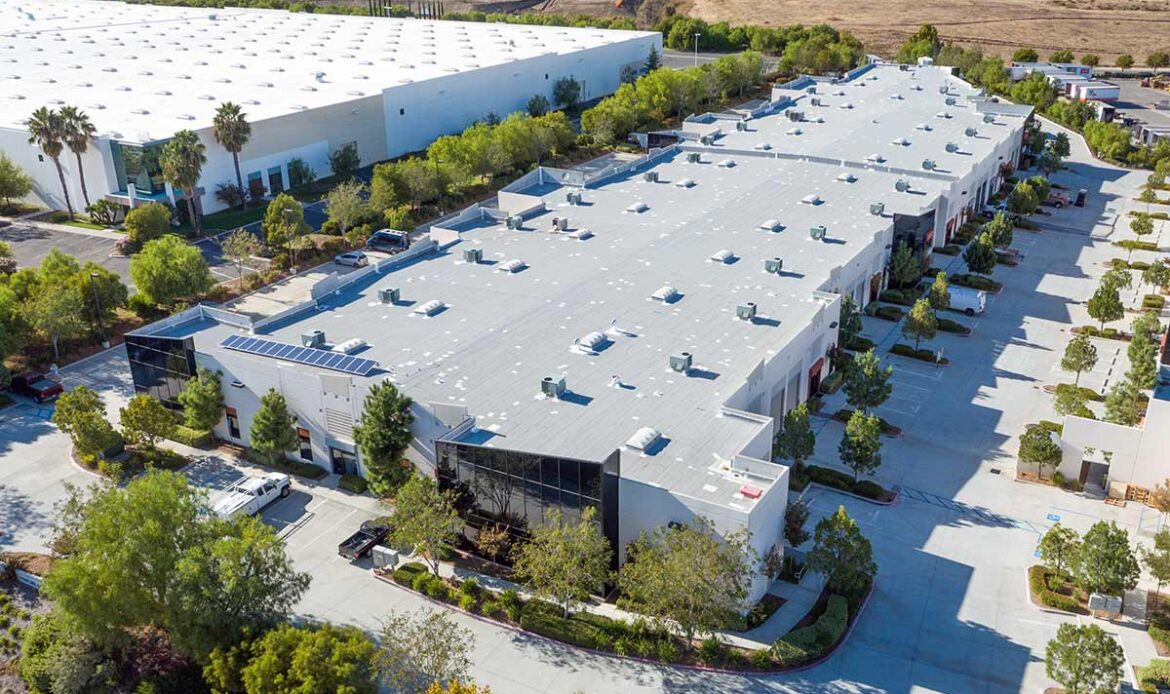
Commercial roofing is a different world from residential roofing, and property owners who assume the two are similar make expensive mistakes. Different materials, different install methods, different failure modes, different insurance dynamics, different vendor economics. This guide walks a Capital Region building owner, HOA board member, or property manager through what they actually need to know — from someone who’s been on Albany, Troy, Schenectady, and Clifton Park commercial roofs since 2016.
If you own or manage a commercial building — an apartment complex, an office park, a retail strip mall, a warehouse, a co-op, a church, a school, a medical building — this piece is written for you. The service-page overview is short. This is the decision framework.
The material decision — what’s actually on your building
Most commercial roofs in the Capital Region are one of four material types.
TPO (Thermoplastic Polyolefin) is the most common single-ply membrane installed on flat and low-slope commercial buildings today. It comes in large white or light-gray rolls, gets welded together with hot air along the seams, and reflects UV effectively. Service life is 20-30 years depending on install quality and thickness. Newer, more energy-efficient than the older systems.
EPDM (Ethylene Propylene Diene Monomer) is the classic rubber roof — the black membrane you see on older commercial buildings. Long track record in Upstate NY, proven cold-weather performance, easily repairable. Service life is 20-30 years, sometimes longer. Doesn’t reflect UV as well as TPO, so it runs hotter under sun and can drive HVAC costs up.
Modified Bitumen (Mod-Bit) is an asphalt-based membrane installed in multiple layers, often with a torched-down or self-adhered top layer. Excellent puncture resistance, good for buildings with foot traffic on the roof (HVAC service, satellite dish maintenance). Service life 15-25 years depending on install quality.
Commercial metal — standing seam or ribbed metal panels — appears on some commercial buildings where architecture calls for it (barns, agricultural, some warehouses). Long service life, high upfront cost.
Coatings aren’t a roof material — they’re a surface treatment applied to an existing roof to extend its service life. Silicone, acrylic, or polyurethane coatings can add 5-15 years to a roof that’s structurally sound but starting to age. We do coating work as a specific service; more below.
Which system is right for your building depends on the current roof’s condition, your budget horizon, energy considerations, and whether you’re planning to hold the building long-term or sell it within a few years. Different answers for each situation.
Coating vs. replacement — the ROI conversation
This is the single most important commercial roof decision for buildings in the 15-to-25-year-old range. The choice: coat the existing roof and extend its life by 5-15 years, or tear off and replace with a fresh membrane.
Coating makes sense when: – The existing membrane is structurally sound (no significant delamination or seam failure) – The insulation underneath is intact – The building will be held for another 5-15 years but not necessarily 30 – Cash flow considerations favor a smaller current-year expense – Energy efficiency gains from a reflective coating are meaningful to operational costs
Replacement makes sense when: – The existing membrane has failed structurally (multiple seam failures, delamination, ponding damage) – The underlying insulation has taken water damage – The building will be held long-term (20+ years) where the coating math wouldn’t fully cover the hold period – Roof geometry changes are planned (new HVAC units, solar installation, etc.) – A full manufacturer warranty for the next 25+ years is worth more than the coating savings
The economics matter here. A typical coating job is 40-60% of the cost of a full replacement, with a shorter warranty and shorter expected service life. On the right roof, the math strongly favors coating. On the wrong roof, coating is just deferring an inevitable replacement while sometimes making the eventual tear-off more complicated.
We walk building owners through this specific analysis on every diagnosis. There’s no one right answer — it depends on your specific roof and your specific hold horizon.
Commercial insurance — the reality check
Commercial roof insurance operates on different mechanics than residential. Property owners who assume the process will look like their homeowner’s claim are often surprised.
Different policy structures. Most commercial buildings carry commercial property policies that treat roof damage differently by claim type. Some cover replacement cost, some actual cash value, some have specific roof age-based exclusions.
Different documentation requirements. Commercial adjusters expect much more detailed documentation than residential adjusters. Xactimate line-item estimates are baseline; some carriers want Symbility or CoreLogic. Photographs need to be more comprehensive. Prior maintenance records may be requested.
Different negotiation dynamics. Commercial claims often involve multiple stakeholders — property manager, ownership group, tenant if triple-net, sometimes lender or lien-holder. Alignment on scope and approval takes longer. Adjusters know this and use time as a negotiating lever.
Different timelines. Commercial claims routinely take 60-120 days from filing to final settlement, sometimes longer. Emergency repairs happen first; final scope negotiations come later.
Supplement claims are more common and more complex. When the actual work exposes damage not visible in the initial adjustment, supplement documentation gets submitted. On commercial jobs this can double or triple the original claim amount when significant deck damage is uncovered.
We handle commercial insurance claims end-to-end for our commercial customers — including being present with the adjuster, writing to industry-standard software specs, and managing supplement requests. This is included in our commercial service.
Vendor selection — what a commercial customer should be asking
Commercial roofing is a specialized trade. The residential contractor down the road may or may not do commercial work well. Here’s what a commercial buyer should ask any roofing vendor they’re considering:
“What’s your commercial project portfolio in the last 24 months?” You want specific answers — building types, membrane types, project sizes. If they can’t rattle off five projects with detail, they may not be the right fit.
“Are you certified by the manufacturers of the systems you install?” TPO and EPDM manufacturers (Carlisle, Firestone, Johns Manville, GAF) certify contractors. Certification affects warranty availability. If they can’t produce certification, some manufacturer warranties won’t apply.
“Who’s on my roof — your crew or a subcontractor?” Some commercial roofers subcontract everything. This isn’t necessarily bad but it changes accountability. Elite is family-owned and my brothers Vlad and Dan work every job with me. That’s the model that works for our clients.
“What’s your safety record and insurance coverage?” OSHA-compliant safety practices matter on commercial jobs. Coverage limits should meet or exceed your requirements as building owner.
“Show me your warranty documentation.” Manufacturer material warranty and workmanship warranty should both be in writing, both specify what’s covered and what isn’t, and both should be transferable to a new owner if you sell.
When to replace vs. maintain — the asset planning frame
The best commercial roof owners think of the roof as an asset with a lifecycle. That means:
Track age. Know when your roof was installed, what the material is, what the warranty is, and when the warranty expires.
Schedule inspections. Every 2-3 years is the industry standard. Semi-annual is better for older roofs. Elite does commercial inspections with a written condition report and photographs.
Address small issues early. Seam failures, punctures from HVAC service, drainage problems — all cheap to fix immediately, expensive to fix once they’ve allowed water into the underlying insulation.
Plan the replacement. Don’t wait for a failure. Budget the eventual replacement into your capital planning, ideally 3-5 years ahead of the projected end-of-life date. This lets you time the market and shop competitive quotes rather than making an emergency decision.
Consider coating as a bridge. For roofs in the 15-25 year range that are structurally sound, coating can add years of life and buy time for a well-planned eventual replacement.
The Elite commercial process
- Initial diagnostic visit with drone footage where useful, written condition report, and photographs
- Written proposal with material recommendation, coating vs. replacement analysis, timeline, cost, warranty
- Insurance claim handling if the work is claim-driven
- Project management including tenant coordination if you’re a multi-tenant property
- Certified installation to manufacturer spec by the same crew that does every Elite job — myself, Vlad, Dan, and our regular crew
- Transferable warranties on materials and workmanship
- Ongoing maintenance program for existing clients
Paul Sandul, Elite Contracting. Family-owned. Owens Corning Preferred. Clifton Park.
Sister topics
- Multi-building HOA/apartment planning: Commercial Roofing Albany — Apartment and Co-op Board Planning Guide
- Contractor selection deep-dive: The Commercial Roof Playbook from Roofing Contractors Albany NY
- Maintenance strategy: Upstate NY Commercial Roof Maintenance Strategy Guide
This is the pillar guide for our commercial roofing service. For the full service overview, portfolio, and consultation scheduling, visit our Commercial Roofing service page. Paul Sandul, Elite Contracting.