

The situations described here are composites drawn from the types of jobs and decisions we encounter regularly. Names and specific figures are illustrative.
The call came in late January, the morning after a forty-degree afternoon flipped back to single digits overnight. A homeowner in Loudonville had two ceiling stains spreading near the front bedroom and a frozen ridge of ice hanging off the eave above the porch. Her shingles were eleven years old, installed by a previous owner. She wanted to know whether the next roof should be metal, and whether that decision would actually solve anything. Conversations like this one are where the question of the best roofing material for Upstate New York stops being abstract. It becomes a set of tradeoffs tied to one specific house, one specific exposure, and one specific budget.
Where the call usually starts
The Loudonville house sat on a slight rise with prevailing winds coming across an open back lot. The roof had two big front-facing gables, a finished bonus room over the garage, and a porch overhang that caught everything sliding off the main slope. The original shingles were a builder-grade three-tab, replaced once around 2014 with mid-range architectural shingles. Eleven years in, the south-facing slope had visible granule loss along the lower courses and a few tabs that had unsealed near the chimney.
The stains inside weren’t from a single failure. They were the trail of a slow ice dam — meltwater backing up under the lowest courses of shingles, refreezing overnight, then pushing further the next afternoon. The shingles weren’t the only cause. The attic above the bonus room had R-19 insulation where R-49 belonged, and the soffit vents on the windward side were partially blocked by old insulation batts. Heat was rising into the roof deck, melting snow unevenly, and feeding the dam.
What the attic told us before the roof did
I always go into the attic before quoting either material. On this house, the attic showed two things that mattered more than the panel-versus-shingle question. First, the bonus room ceiling had no air sealing at the can lights — every fixture was leaking warm interior air directly into the roof assembly. Second, the ridge vent had been installed but never fully cut through the decking, so the airflow path was technically present and functionally dead.
A metal roof installed over those two problems would still get ice dams. Maybe smaller, maybe slower, but they would still form. That’s the part of the conversation homeowners don’t always expect. The roof material handles the weather; the assembly underneath decides whether the weather causes damage. In our climate, the assembly often matters more than the panel.
The numbers the homeowner actually wanted
She asked the question every homeowner asks at this point: what’s the cost difference, and is metal worth it? Honest answer: for her house, on her timeline, the math wasn’t lopsided in either direction. Here’s the working range I gave her, knowing roof complexity and access change everything:
- Architectural shingles with full ice and water shield, ridge vent repair, attic air sealing, and insulation upgrade: roughly $14,000 to $18,000 installed.
- Standing seam metal with the same air sealing and insulation work, snow guards above the porch and front door, custom valley flashing: roughly $34,000 to $42,000 installed.
Architectural shingles in this region typically last 18 to 25 years when the attic is healthy. Standing seam metal commonly runs 40 to 60 years with periodic fastener and sealant checks. If she planned to stay 8 to 12 years, the math favored shingles plus the assembly fixes. If she planned to stay 25-plus years or hand the house down, the metal started to make sense — partly because the second shingle replacement around year 22 would land at materially higher prices, and partly because the standing seam pairs cleanly with the solar she mentioned considering down the road.
The misconception that shifted the decision
She had heard, from a neighbor, that metal roofs are louder in rain and colder in winter. Both are repeatable assumptions in the Capital Region, and both are wrong on a properly built residential roof. Rain noise on metal is a function of decking and underlayment. Over solid plywood sheathing with a synthetic underlayment and a properly insulated attic, the sound level inside the bonus room would be indistinguishable from a shingle roof. The pole-barn comparison is the source of the myth — and pole barns are built without any of those layers.
Winter cold inside the house has almost nothing to do with the panel on top. It has to do with attic insulation, air sealing at penetrations, and whether the ceiling plane is continuous. Once she understood that, the metal-versus-shingle question stopped feeling like a comfort question. It became a question about lifespan and roof geometry.
What we actually built, and why
The roof geometry pushed the answer. Her front gables were simple, steep, and exposed to wind — ideal for metal. The bonus room dormer had two valleys and three penetrations, which would have been workable in metal but pricier. Her ownership horizon was at least twenty years; her children were still in elementary school and she was not planning to move.
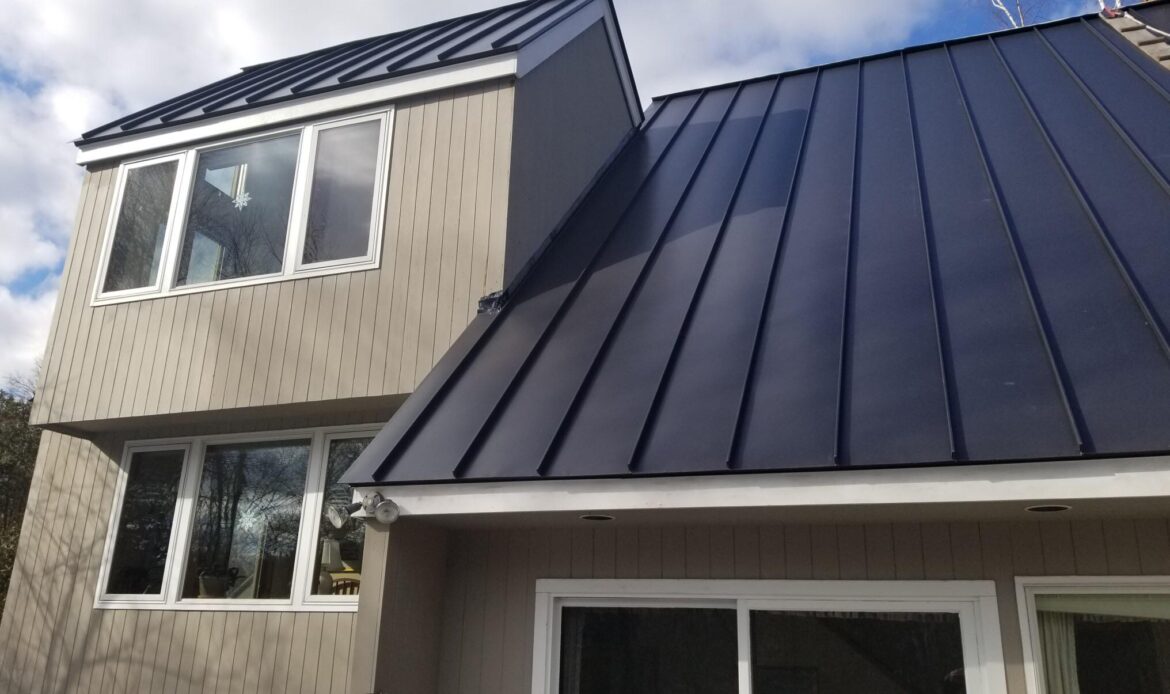
We went with standing seam metal on the main field, with custom-formed valley pans where the dormer met the main slope. Snow guards were staged above the front porch and over the side entry, because the prevailing wind direction meant snow would otherwise dump exactly where deliveries got dropped. The bonus room attic got dense-pack cellulose to R-60, full air sealing at every can light and bath fan, and the ridge vent was actually cut through this time. The eaves got six feet of ice and water shield instead of the code-minimum three.
If you want to see how the full roof replacement process reads on a job like this, it isn’t dramatically different from a shingle install in the early phases. The tear-off, deck inspection, and underlayment work happen the same way. The metal installation itself takes longer and demands more precise flashing detail, which is where installer experience earns its keep.
A pause for what readers usually ask
Around this point in any roofing conversation, homeowners tend to ask the same handful of questions. I’ll cover them the way they usually come up.
The first one is almost always about hail. Most homeowners have seen a neighbor’s dented metal awning and assume a hail event will leave the roof looking like a golf ball. On 24-gauge standing seam, that’s not what happens. The panels resist denting at the gauge weights we use on residential roofs. Cosmetic dents can occur on lighter aluminum profiles. What rarely happens, in either case, is a leak — because the seams sit above the panel surface, the impact stays cosmetic. Shingles, by contrast, lose granules in hail, which shortens their useful life even when no leaks appear.
The second question is about wind. The Loudonville house faced open exposure, and the homeowner had watched a neighbor lose half a slope of shingles in a 2023 windstorm. Interlocked metal panels distribute wind load across clips and fasteners along the entire run. Shingles fight uplift at every tab edge, and once one tab unseals, the failure tends to cascade. On exposed lots, that pattern shows up in our service calls every windy spring.
The third question is usually about resale. There’s no clean answer. In some Capital Region neighborhoods, a standing seam roof reads as a premium upgrade and supports a higher list price. In others, it reads as unusual and doesn’t move the needle. The honest framing is this: if you’re staying long enough to use the lifespan, the roof pays for itself in avoided replacement. If you’re selling within five years, the resale bump rarely covers the cost premium.
What changed after the next nor’easter
The job wrapped in late September. The first real test came in February, when a wet storm dropped fourteen inches over thirty-six hours, followed by a forty-five-degree afternoon. The homeowner sent a photo of the main slope nearly clear by Tuesday morning — snow sliding off in sheets, hung up cleanly above the porch where the snow guards held it. The eaves had no ice ridge. The ceilings inside stayed dry.
The bonus room, which had run noticeably colder than the rest of the upstairs the previous winter, was now within two degrees of the main thermostat. That wasn’t the metal. That was the air sealing and insulation. The roof above it was doing its job, which on this house meant shedding water and surviving wind. The comfort improvement came from the assembly under it.
Where the answer changes for a different house
I want to be careful not to make this sound like metal is always the right call. Half a mile from the Loudonville house, there’s a 1920s craftsman with five intersecting valleys, two dormers, three skylights, and a slate-look composite roof the owner loved. On that geometry, custom metal flashing at every valley would have pushed the price past the point where the lifespan math made sense. We went with high-end architectural shingles, full ice and water shield, balanced ventilation, and a fifteen-year ownership horizon. That roof is doing exactly what it should.
For homeowners trying to assess their own situation, the right question isn’t metal or shingles in isolation. It’s a sequence: what does the attic look like, how exposed is the lot, how long is the ownership horizon, how complex is the roof geometry, and where does the budget actually allow you to invest? Sometimes the highest-leverage spending is on the assembly layers under the panel, not the panel itself. A good roofer will tell you when that’s true.
If you’re weighing the same question, our roof repair work often catches the underlying assembly issues that decide whether your next full replacement actually solves the problem. The decisions that protect a Capital Region home through freeze-thaw cycles, wet snow, and exposed-lot winds are rarely the ones a national contractor would default to. They’re worked out one attic, one slope, one valley at a time.
What the Loudonville job changed for the homeowner
A year out, the homeowner told me the thing she noticed most wasn’t the look of the roof. It was that she stopped scanning her ceilings for stains every time the temperature swung. The mental load of waiting for the next leak was gone. She also mentioned that her energy bills had dropped enough to be noticeable, which she initially attributed to the metal and which I told her, again, was the insulation work doing the real lifting.
For anyone in the Capital Region looking at a similar decision, the best roofing material for Upstate New York isn’t a single material. It’s the material that fits your roof’s geometry, your attic’s condition, and how long you plan to live with the result. The right contractor will walk you through that math openly, including the parts where the answer isn’t the one that costs the most. For homeowners weighing options similar to the case above, our broader notes on metal roof installation cost, timeline, and process may be a useful next read.
More on Metal Roofing from Elite Contracting
The full decision walkthrough is in our pillar guide: The Metal Roof Decision.
For service overview, project timelines, and free estimate scheduling, visit our Metal Roofing service page.